Plan d’maintenance Audi Q7 Phase 2
Logo Audi

Service book en ligne

Generations :Q7 Phase 1Q7 Phase 2All →
Logo Audi

📖Audi Q7 4M: the big Audi SUV became lighter, but not any simpler

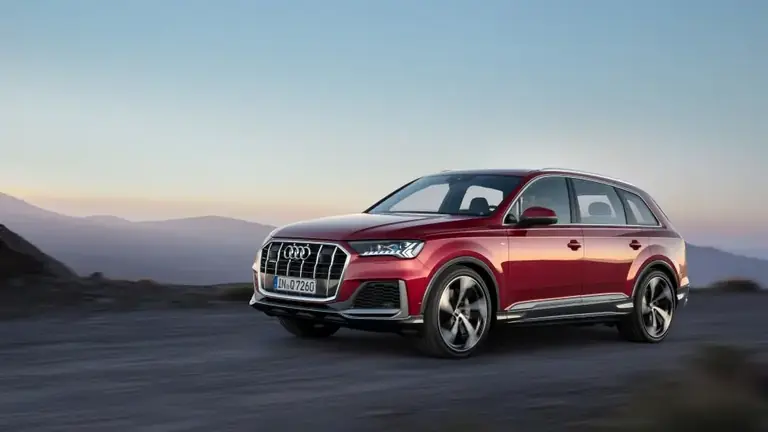
Audi Q7 Phase 2 (2015-Présent)

Launched in 2015, the Audi Q7 `4M` moved to the `MLB evo` platform and made the brand's big SUV formula noticeably lighter than the old `4L`. Against the BMW X5, it still prioritises comfort, cabin space and long-distance travel, but with a far more modern presentation and a level of electronics that changes the maintenance picture completely. This is no longer a blunt heavyweight; it is a large premium SUV that depends heavily on proper follow-up.

Most of the market revolves around the `3.0 TDI V6` in `218` and `272 hp` form, with some `2.0 TFSI`, `3.0 TFSI` and `e-tron quattro` plug-in hybrids in certain years. The `8-speed tiptronic` is standard, `quattro` remains central, and depending on version the car adds `Virtual Cockpit`, more advanced driver aids, optional air suspension and rear-wheel steering. On the road the progress is obvious, but any maintenance delay becomes expensive just as quickly on something this complex.

Suivi free

Entrez votre number plate d’number plate afin de suivre freeement votre Q7 Phase 2

Garajo prépare votre garage et vous permet ensuite de suivre les maintenances, les rappels et les points à surveiller.

F
76

Owner notes

The reassuring points, known weak spots and deadlines you should not let slip.

Reassuring points

Reliability
  • The `3.0 TDI` in the Q7 4M remains a convincing long-distance engine when use was not limited to short trips and emissions hardware was followed properly.
  • The `8-speed tiptronic` handles the torque and weight well when serviced at sensible intervals.
  • The `4M` chassis is clearly more polished than the old `4L`, with a real gain in comfort and accuracy over distance.
  • An example that is healthy in `12 V` supply, electronics and suspension can still offer reasonable ownership costs for the segment.

Chronic weak spots

Keep an eye on
  • `3.0 TDI V6`: inspect `EGR`, `DPF`, `AdBlue`, regeneration frequency and any short-trip history, especially after `120,000 km`.
  • Cooling on the diesel or petrol `V6`: look for any leak traces, hot smells and temperature inconsistency after slow traffic followed by motorway use.
  • Optional air suspension: test lift, lowering and level retention after an overnight stop.
  • `12 V` battery, `MMI`, Virtual Cockpit and driver aids: note any intermittent faults and any slow electronic wake-up.
  • `Q7 e-tron quattro`: verify `AC` charging, plausible electric range and the absence of jolts when switching between combustion and electric drive.

Critical deadlines

Do not miss
  • Service the `tiptronic` before jerks or slip appear, especially on cars that tow or run heavily loaded.
  • Treat any `3.0 TDI` emissions drift early before `EGR`, `DPF` and `AdBlue` all land on the same invoice.
  • Do not let a weak `12 V` battery distort the whole electronic diagnosis of the vehicle.
  • On the plug-in hybrid, document any loss of charge, socket fault or cooling inconsistency immediately.

Fréquences d'maintenance recommandées

Motorisations thermiques

Repères d’entretien pour les versions thermiques. Les périodicités exactes varient selon le moteur et l’année.

Oil change

Every 15 000 km

Tous les 1 an

Service

Every 15 000 km

Tous les 1 an

Brake pads

Every 30 000 km

Tous les 2 ans

Poids ou puissance élevés : usure des number platettes accélérée sur certaines versions

Timing belt / chain

Timing chain - designed to last, no scheduled replacement

Battery (12 V)

Every 50 000 km

Tous les 4 ans

Diesel particulate filter (DPF)

Every 100 000 km

Automatic regeneration while driving: regularly do 20 min on a fast road; preventive clean around 100,000 km

EGR valve

Every 80 000 km

Valve that soots up easily on diesels: a preventive clean avoids power loss and limp mode

Motorisations hybrides

Repères d’entretien pour les versions hybrides. Vidange, freins et contrôles système doivent rester synchronisés.

Oil change

Every 15 000 km

Tous les 1 an

Service

Every 15 000 km

Tous les 1 an

Brake pads

Every 30 000 km

Tous les 2 ans

Poids ou puissance élevés : usure des number platettes accélérée sur certaines versions

Timing belt / chain

Timing chain - designed to last, no scheduled replacement

Battery (12 V)

Every 50 000 km

Tous les 4 ans

Powertrains and average consumption

This generation is available with several powertrains. The consumption figures come from manufacturer data for each version.

Motorisations thermiques
Motorisations hybrides

Estimated average budget

Premium cost

L'maintenance d'une Audi Q7 Phase 2 se situe environ 64% au-dessus de la moyenne du marché (positionnement premium).

Vidange simple~160
Révision complète~485
Freins avant (Plaquettes)~230
Kit distribution~885
Pneus (les 4)~615

Prix indiqué pour les motorisations à courroie ; certaines versions sont à chaîne (pas d'échéance).

* Indicative estimates for parts and labour.

Frequently asked questions about Audi Q7 Phase 2

Quel est le plan d’maintenance d’une Audi Q7 Phase 2 ?
Pour une Audi Q7 Phase 2, le plan d’maintenance part d’une service tous les 15 000 km ou 1 an : oil change si concernée, freins, tyres, MOT et suivi du carnet constructeur.
Quelle est la périodicité d’maintenance d’une Audi Q7 Phase 2 ?
La périodicité d’maintenance d’une Audi Q7 Phase 2 dépend de la motorisation, de l’année et de l’usage. Selon le profil moteur (thermique : 11 ; hybride : 29), adaptez les échéances au carnet constructeur et à vos trajets.
Où trouver le programme d’maintenance constructeur pour une Audi Q7 Phase 2 ?
Le programme d’entretien constructeur de la Audi Q7 Phase 2 se trouve dans le carnet constructeur, l’espace client de la marque ou auprès du réseau Audi. Garajo vous aide ensuite à suivre ces échéances dans un carnet numérique.
L'maintenance est-il le même sur toutes les versions de Q7 Phase 2 ?
Non. La Q7 Phase 2 existe selon les cas en thermique ou hybride. Les opérations diffèrent selon la motorisation, notamment pour la vidange/distribution côté thermique et les contrôles spécifiques des versions hybrides.
What are the common problems on the Q7 Phase 2?
Q7 Phase 2 owners should especially watch: `3.0 TDI V6`: inspect `EGR`, `DPF`, `AdBlue`, regeneration frequency and any short-trip history, especially after `120,000 km`. Cooling on the diesel or petrol `V6`: look for any leak traces, hot smells and temperature inconsistency after slow traffic followed by motorway use. Garajo includes these watch points so you can act early.
Combien coûte l'maintenance d'une Audi Q7 Phase 2 ?
Le budget d'maintenance d'une Audi Q7 Phase 2 se situe environ 64% au-dessus de la moyenne du marché (positionnement premium). Comptez par exemple environ 485 € pour une service complète. Garajo estime votre budget selon la motorisation et suit vos dépenses réelles, freeement.
Which Audi Q7 Phase 2 powertrain is best for town use?
Audi Q7 Phase 2 mix: thermique : 11 versions ; hybride : 29 versions. Pour la ville, privilégiez les versions hybrids ; elles restent plus efficientes dans les arrêts fréquents. The range is mostly hybride (29 of 40).
Which Audi Q7 Phase 2 powertrain should you choose if you mostly drive on the motorway?
Audi Q7 Phase 2 mix: thermique : 11 versions ; hybride : 29 versions. For regular motorway use, diesel versions of this model are usually the best fit (range and refinement at a steady speed). The range is mostly hybride (29 of 40).

Compatible engine oil

Which engine oil for Audi Q7 Phase 2?

These links are limited to the engines of this generation when oil data is available.

Unsure between two viscosities?5W-30 vs 0W-300W-20 vs 0W-305W-30 vs 5W-40

Ne ratez plus jamais un maintenance

Gérez l'maintenance de votre Audi Q7 Phase 2 freeement.
Centralise your history and spending in a few clicks.Téléchargez le service book de votre Audi Q7 Phase 2 en PDF à tout moment.

Créer mon carnet (Free)