
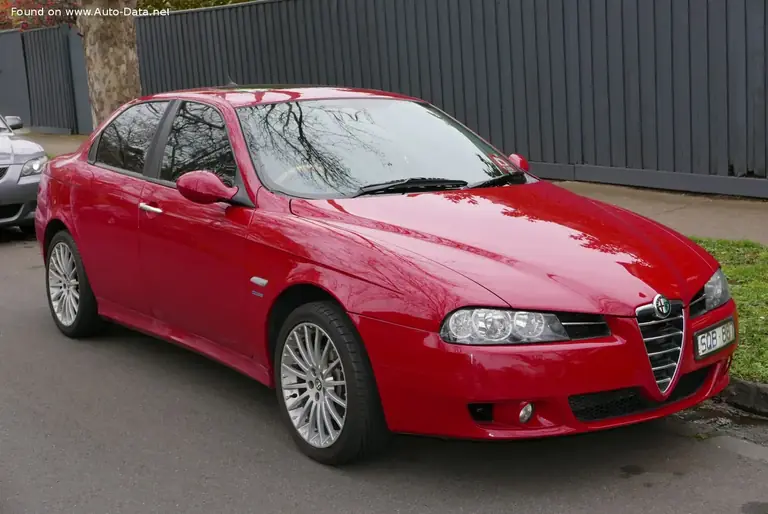
Plan d’maintenance Alfa Romeo Alfa 156 II
Logo Alfa Romeo

Service book en ligne

Generations :Alfa 156 IAlfa 156 IIAll →
Logo Alfa Romeo

📖Alfa Romeo 156 II: the 2003 facelift is more mature, but also more sensitive to engine follow-up and front-end wear

Alfa Romeo Alfa 156 II (2003-2006)

The 2003 facelift made the 156 feel more mature and a little richer, without losing what made it interesting. It is still an Alfa first judged on front-axle condition and engine health rather than presentation.

This phase also adds complexity: alongside the remaining Twin Spark engines come the `2.0 JTS`, `1.9 JTD` `115` or `140 hp`, the `2.4 JTD 175 hp`, and in some versions the `2.5 V6`. The facelift is better, but much less tolerant of neglected maintenance.

Suivi free

Entrez votre number plate d’number plate afin de suivre freeement votre Alfa 156 II

Garajo prépare votre garage et vous permet ensuite de suivre les maintenances, les rappels et les points à surveiller.

F
76

Owner notes

The reassuring points, known weak spots and deadlines you should not let slip.

Reassuring points

Reliability
  • The facelift keeps the 156's strong chassis while bringing a more mature package overall.
  • The `1.9 JTD 140` and `2.4 JTD 175` finally give the car real diesel long-leg ability.
  • A healthy example still shows itself quickly through front-end precision and smooth engine delivery.

Chronic weak spots

Keep an eye on
  • The `2.0 JTS` `937 A1.000` needs close attention to carbon build-up, idle quality, coils and oil use.
  • JTD `937 A2.000`, `192 A5.000` and `841 G.000` need EGR, intake, turbo, MAF and oil-quality checks.
  • The `AR 32405` V6 must have clear cooling, belt and leak history.
  • Upper wishbones, bushes, anti-roll-bar parts and steering-rack wear remain standard front-end pain points.

Critical deadlines

Do not miss
  • Twin Spark and JTS engines still need yearly oil service and strict timing-belt discipline.
  • On JTD engines, shorter oil and filter intervals are wise when history is incomplete.
  • Brake fluid, coolant and geometry reset should be part of early catch-up work.
  • On V6 and Crosswagon-type cars, do not postpone cooling, transmission or suspension work.

Fréquences d'maintenance recommandées

Repères d’entretien pour les versions thermiques. Les périodicités exactes varient selon le moteur et l’année.

Oil change

Every 15 000 km

Tous les 1 an

Service

Every 15 000 km

Tous les 1 an

Brake pads

Every 40 000 km

Tous les 2 ans

Timing belt / chain

Every 100 000 km

Tous les 5 ans

Battery (12 V)

Every 50 000 km

Tous les 4 ans

Powertrains and average consumption

Average consumption from manufacturer data for the versions available in this generation.

Motorisations thermiques

Estimated average budget

Intermédiaire cost

L'maintenance d'une Alfa Romeo Alfa 156 II se situe légèrement supérieur (28%) à la moyenne du marché.

Vidange simple~125
Révision complète~375
Freins avant (Plaquettes)~170
Kit distribution~825
Pneus (les 4)~360

* Indicative estimates for parts and labour.

Frequently asked questions about Alfa Romeo Alfa 156 II

Quel est le plan d’maintenance d’une Alfa Romeo Alfa 156 II ?
Pour une Alfa Romeo Alfa 156 II, le plan d’maintenance part d’une service tous les 15 000 km ou 1 an : oil change si concernée, freins, tyres, MOT et suivi du carnet constructeur.
Quelle est la périodicité d’maintenance d’une Alfa Romeo Alfa 156 II ?
La périodicité d’maintenance d’une Alfa Romeo Alfa 156 II dépend de la motorisation, de l’année et de l’usage. Selon le profil moteur (thermique : 9), adaptez les échéances au carnet constructeur et à vos trajets.
Où trouver le programme d’maintenance constructeur pour une Alfa Romeo Alfa 156 II ?
Le programme d’entretien constructeur de la Alfa Romeo Alfa 156 II se trouve dans le carnet constructeur, l’espace client de la marque ou auprès du réseau Alfa Romeo. Garajo vous aide ensuite à suivre ces échéances dans un carnet numérique.
What are the common problems on the Alfa 156 II?
Alfa 156 II owners should especially watch: The `2.0 JTS` `937 A1.000` needs close attention to carbon build-up, idle quality, coils and oil use. JTD `937 A2.000`, `192 A5.000` and `841 G.000` need EGR, intake, turbo, MAF and oil-quality checks. Garajo includes these watch points so you can act early.
Quand remplacer la courroie de distribution sur une Alfa 156 II ?
The timing belt is usually replaced every 100 000 km or 5 ans on this type of engine.
Où trouver le service book de la Alfa Romeo Alfa 156 II ?
Garajo propose un digital service book free, toujours à jour, avec rappels et historique détaillé pour votre Alfa Romeo Alfa 156 II.
Combien coûte l'maintenance d'une Alfa Romeo Alfa 156 II ?
Le budget d'maintenance d'une Alfa Romeo Alfa 156 II se situe légèrement supérieur (28%) à la moyenne du marché. Comptez par exemple environ 375 € pour une service complète. Garajo estime votre budget selon la motorisation et suit vos dépenses réelles, freeement.
Which Alfa Romeo Alfa 156 II powertrain is best for town use?
Ce modèle est seulement en petrol/diesel. Fuel mix: 6 motorisations essence ; 3 motorisations diesel. Pour la ville, les versions petrol/GPL sont généralement plus cohérentes ; les versions diesel sont plutôt pertinentes avec des trajets longs réguliers.
Which Alfa Romeo Alfa 156 II powertrain should you choose if you mostly drive on the motorway?
Ce modèle est seulement en petrol/diesel. Fuel mix: 6 motorisations essence ; 3 motorisations diesel. For regular motorway use, diesel versions of this model are usually the best fit (range and refinement at a steady speed).

Compatible engine oil

Which engine oil for Alfa Romeo Alfa 156 II?

These links are limited to the engines of this generation when oil data is available.

Unsure between two viscosities?5W-40 vs 10W-405W-30 vs 5W-400W-20 vs 5W-30

Ne ratez plus jamais un maintenance

Gérez l'maintenance de votre Alfa Romeo Alfa 156 II freeement.
Centralise your history and spending in a few clicks.Téléchargez le service book de votre Alfa Romeo Alfa 156 II en PDF à tout moment.

Créer mon carnet (Free)