Plan d’maintenance BYD Qin Pro II
Logo BYD

Online service book

Logo BYD

📖BYD Qin Pro: stylish fastback saloon demanding careful turbo and DCT care

BYD Qin Pro II (2018-2021)

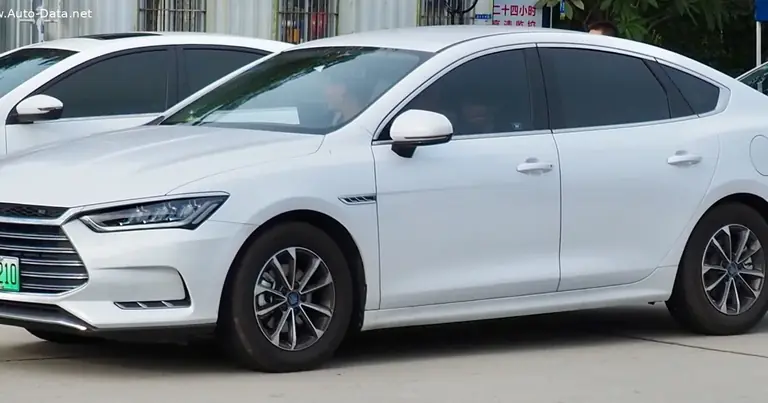
Launched in 2018, the Qin Pro introduced BYD's modern 'Dragon Face' design language to the compact executive saloon market, offering sleek fastback styling and upgraded cabin comfort. Keeping this handsome saloon dependable calls for regular BYD Qin maintenance, balancing combustion engine servicing with electrified powertrain diagnostics.

The mechanical range encompasses a 1.5-litre turbo petrol engine paired with a six-speed dual-clutch gearbox, a DM plug-in hybrid, and pure EV models with up to 56.4 kWh battery capacity. All variants benefit from a robust timing chain valvetrain and rely on an active liquid cooling loop regulating engine, inverter and battery temperatures.

Prospective buyers should test the DCT transmission in stop-start traffic to confirm smooth clutch engagement without judder. Inspect direct-injection intake valves for carbon build-up on petrol models, verify 12 V battery health, and examine high-voltage battery health (SOH) diagnostics on electrified versions.
Suivi free

Entrez votre number plate d’number plate afin de suivre freeement votre Qin Pro II

Garajo prépare votre garage et vous permet ensuite de suivre les maintenances, les rappels et les points à surveiller.

UKGB

Owner notes

The reassuring points, known weak spots and deadlines you should not let slip.

Reassuring points

Reliability
  • Versatile DM plug-in hybrid powertrain offering brisk performance and flexible commuting capability.
  • Durable traction battery pack with reported capacity retention exceeding 85% after years of service.
  • Timing chain engine valvetrain eliminating the costly scheduled replacement associated with rubber cambelts.
  • Effective regenerative braking significantly reducing brake pad and disc friction wear.

Chronic weak spots

Keep an eye on
  • High-voltage cell consistency: check vehicle service history for battery module calibration campaigns via dealer VIN search.
  • Direct-injection intake valve coking: direct fuel injection can cause valve carbon build-up; inspect or decoke from 60,000 km.
  • Unprompted engine start-up: monitor automatic combustion engine start-ups triggered by fuel preservation cycles in EV mode.
  • Auxiliary 12 V battery drain: check the low-voltage battery annually to prevent spurious electrical control errors.
  • Valve cover and timing case weeping: inspect engine gaskets for minor oil seepage as rubber seals age.

Critical deadlines

Do not miss
  • Engine oil and filter change: renew 5W-30 synthetic oil every 10,000 km or 12 months (5,000-7,500 km for heavy city use).
  • Brake fluid service: flush DOT 4 hydraulic fluid every 24 months to maintain regenerative-to-friction brake blending.
  • Traction battery health scan: perform full high-voltage state-of-health diagnostic check during annual service.
  • Transmission and reduction gearbox fluid: inspect gearbox oil level every 40,000 km; replace at 60,000 km.

Fréquences d'maintenance recommandées

Electric powertrains

Service markers for electric versions. Petrol/diesel engine jobs do not apply.

Service

Every 15 000 km

Every 1 year

Check the electrical system

Every 15 000 km

Every 1 year

Traction battery diagnosis

Every 15 000 km

Every 1 year

Battery coolant

Every 120 000 km

Every 10 years

Brake pads

Every 60 000 km

Every 2 years

Freinage régénératif : number platettes préservées, mais faites contrôler la corrosion des disques

Battery (12 V)

Every 50 000 km

Every 4 years

Hybrid powertrains

Service markers for hybrid versions. Oil changes, brakes and system checks need to stay in step.

Oil change

Every 15 000 km

Every 1 year

Service

Every 15 000 km

Every 1 year

Brake pads

Every 30 000 km

Every 2 years

Poids ou puissance élevés : usure des number platettes accélérée sur certaines versions

Timing belt / chain

Every 100 000 km

Every 5 years

Battery (12 V)

Every 50 000 km

Every 4 years

Powertrains and average consumption

This generation is available with several powertrains. The consumption figures come from manufacturer data for each version.

Electric powertrains

Fully electric versions. Servicing focuses on the high-voltage system, charging and battery monitoring.

Hybrid powertrains

HEV, MHEV and PHEV versions. They combine petrol/diesel servicing with hybrid-system checks.

Estimated average budget

Mid-range cost

Servicing a BYD Qin Pro II sits slightly above the market average (+15%).

Simple oil change~100
Full service~315
Front brake pads~155
Timing-belt kit~650
Tyres (set of 4)~450

* Indicative estimates for parts and labour.

Frequently asked questions about BYD Qin Pro II

Is servicing the same on every Qin Pro II version?
No. The Qin Pro II is available as petrol/diesel, hybrid or electric depending on the version. The jobs differ by powertrain, especially oil change and timing belt on combustion engines, and battery/electrical-system checks on EVs.
Which service markers apply to an electric Qin Pro II?
On fully electric versions, plan an electrical-system and traction-battery check around 15,000 km / 1 year, and battery coolant around 120,000 km / 10 years (always confirm with the manufacturer).
What are the common problems on the Qin Pro II?
Qin Pro II owners should especially watch: High-voltage cell consistency: check vehicle service history for battery module calibration campaigns via dealer VIN search. Direct-injection intake valve coking: direct fuel injection can cause valve carbon build-up; inspect or decoke from 60,000 km. Garajo includes these watch points so you can act early.
How much does it cost to service a BYD Qin Pro II?
The service budget for a BYD Qin Pro II sits slightly above the market average (+15%). Allow about 315 € for a full service, for example. Garajo estimates your budget by powertrain and tracks what you actually spend, for free.
Which BYD Qin Pro II powertrain is best for town use?
BYD Qin Pro II mix: hybrid : 2 versions ; electric : 3 versions. For mostly urban use, prefer electric versions first, then hybrids (full hybrid / mild hybrid) to keep consumption down in dense traffic. The range is mostly electric (3 of 5).
Which BYD Qin Pro II powertrain should you choose if you mostly drive on the motorway?
BYD Qin Pro II mix: hybrid : 2 versions ; electric : 3 versions. For frequent motorway use, a plug-in hybrid still makes sense if you charge regularly in town; otherwise an equivalent petrol/diesel version is often more coherent. The range is mostly electric (3 of 5).

Ne ratez plus jamais un maintenance

Gérez l'maintenance de votre BYD Qin Pro II freeement.
Centralise your history and spending in a few clicks.Téléchargez le service book de votre BYD Qin Pro II en PDF à tout moment.

Créer mon carnet (Free)