Plan d’maintenance Citroen Saxo Phase 1
Logo Citroen

Online service book

Generations :Saxo Phase 1Saxo Phase 2All →
Logo Citroen

📖Citroën Saxo I: the lightweight supermini with hot-hatch pedigree

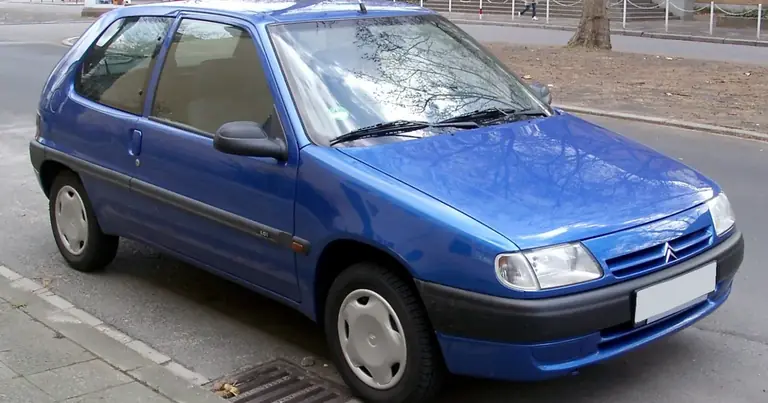
Citroen Saxo Phase 1 (1996-1999)

Launched in 1996 to replace the AX, the first-generation Citroën Saxo shared its agile platform with the Peugeot 106. Available in 3- and 5-door formats, it ranged from frugal 1.0-litre commuter runabouts to the legendary 1.6 16V VTS producing 120 hp. Dedicated Citroën Saxo maintenance is essential today to preserve this appreciating nineties youngtimer.

Under the lightweight bonnet, the robust TU petrol engine family (1.1, 1.4 and 1.6) requires strict adherence to the cambelt kit renewal every 60,000 km or 5 years. Valvetrain simplicity is matched by durable manual gearboxes, though hard-driven VTS variants place elevated stress on front wheel bearings and lower suspension wishbone ball joints.

Chassis integrity is the defining inspection area on cars of this vintage. Unchecked underbody corrosion on sills, boot floors, inner wheel arches and jacking points can render an otherwise sound car unroadworthy, while PSA’s classic trailing-arm rear axle demands prompt attention to worn needle roller bearings.

Suivi free

Entrez votre number plate d’number plate afin de suivre freeement votre Saxo Phase 1

Garajo prépare votre garage et vous permet ensuite de suivre les maintenances, les rappels et les points à surveiller.

UKGB

Owner notes

The reassuring points, known weak spots and deadlines you should not let slip.

Reassuring points

Reliability
  • Featherweight kerb weight delivering communicative handling, nimble steering and pure nineties driving feedback.
  • Straightforward mechanical accessibility and robust TU petrol engines that are remarkably inexpensive to maintain.
  • Cult youngtimer status, particularly for clean, unmodified VTS 16V hot-hatch examples.

Chronic weak spots

Keep an eye on
  • Underbody corrosion: thoroughly inspect outer sills, rear inner arches, boot floorpan, battery tray and jacking points.
  • TU engine cambelt: replace belt, tensioner and water pump every 60,000 km or 5 years without delay.
  • Rear trailing-arm axle: check for excessive negative camber, tyre sidewall scrubbing and squeaking needle roller bearings.
  • VTS 1.6 16V exhaust manifold: inspect cast manifold for hairline heat cracks caused by aggressive driving or track use.
  • Front wheel bearings: listen for rumbling drone when cornering, especially on spiritedly driven VTR and VTS models.

Critical deadlines

Do not miss
  • Renew the cambelt kit and water pump every 60,000 km or 5 years to prevent catastrophic valvetrain destruction.
  • Inspect and rebuild rear axle trailing-arm bearings at the earliest hint of wheel camber tilt before the axle tube is scored.
  • Apply rust prevention sealant to sills, floor seams and rear wheel arches before structural corrosion sets in.
  • Flush engine coolant and replace the thermostat every 3 years to protect the alloy TU cylinder head gasket.

Fréquences d'maintenance recommandées

Petrol and diesel powertrains

Service markers for petrol/diesel versions. Exact intervals vary by engine and model year.

Oil change

Every 15 000 km

Every 1 year

Service

Every 15 000 km

Every 1 year

Brake pads

Every 40 000 to 50 000 km

Every 2 years

Vehicle léger et modeste : usure des number platettes généralement modérée

Timing belt / chain

Every 100 000 km

Every 5 years

Battery (12 V)

Every 50 000 km

Every 4 years

Electric powertrains

Service markers for electric versions. Petrol/diesel engine jobs do not apply.

Service

Every 15 000 km

Every 1 year

Check the electrical system

Every 15 000 km

Every 1 year

Traction battery diagnosis

Every 15 000 km

Every 1 year

Battery coolant

Every 120 000 km

Every 10 years

Brake pads

Every 60 000 km

Every 2 years

Freinage régénératif : number platettes préservées, mais faites contrôler la corrosion des disques

Battery (12 V)

Every 50 000 km

Every 4 years

Powertrains and average consumption

This generation is available with several powertrains. The consumption figures come from manufacturer data for each version.

Petrol and diesel powertrains
Electric powertrains

Fully electric versions. Servicing focuses on the high-voltage system, charging and battery monitoring.

Saxo (Phase I, 1996) 3-door

Estimated average budget

Standard cost

Servicing a Citroen Saxo Phase 1 sits in line with the market average.

Simple oil change~85
Full service~250
Front brake pads~110
Timing-belt kit~650
Tyres (set of 4)~400

* Indicative estimates for parts and labour.

Frequently asked questions about Citroen Saxo Phase 1

Is servicing the same on every Saxo Phase 1 version?
No. The Saxo Phase 1 is available as petrol/diesel, hybrid or electric depending on the version. The jobs differ by powertrain, especially oil change and timing belt on combustion engines, and battery/electrical-system checks on EVs.
Which service markers apply to an electric Saxo Phase 1?
On fully electric versions, plan an electrical-system and traction-battery check around 15,000 km / 1 year, and battery coolant around 120,000 km / 10 years (always confirm with the manufacturer).
What are the common problems on the Saxo Phase 1?
Saxo Phase 1 owners should especially watch: Underbody corrosion: thoroughly inspect outer sills, rear inner arches, boot floorpan, battery tray and jacking points. TU engine cambelt: replace belt, tensioner and water pump every 60,000 km or 5 years without delay. Garajo includes these watch points so you can act early.
How much does it cost to service a Citroen Saxo Phase 1?
The service budget for a Citroen Saxo Phase 1 sits in line with the market average. Allow about 250 € for a full service, for example. Garajo estimates your budget by powertrain and tracks what you actually spend, for free.
Which Citroen Saxo Phase 1 powertrain is best for town use?
Citroen Saxo Phase 1 mix: petrol/diesel : 12 versions ; electric : 1 version. In town, electric versions fit best thanks to energy recuperation and the absence of cold-start cycles. The range is mostly petrol/diesel (12 of 13).
Which Citroen Saxo Phase 1 powertrain should you choose if you mostly drive on the motorway?
Citroen Saxo Phase 1 mix: petrol/diesel : 12 versions ; electric : 1 version. For regular motorway use, diesel versions of this model are usually the best fit (range and refinement at a steady speed). The range is mostly petrol/diesel (12 of 13).

Compatible engine oil

Which engine oil for Citroen Saxo Phase 1?

These links are limited to the engines of this generation when oil data is available.

Unsure between two viscosities?5W-30 vs 5W-405W-40 vs 10W-405W-40 vs 0W-40

Ne ratez plus jamais un maintenance

Gérez l'maintenance de votre Citroen Saxo Phase 1 freeement.
Centralise your history and spending in a few clicks.Téléchargez le service book de votre Citroen Saxo Phase 1 en PDF à tout moment.

Créer mon carnet (Free)