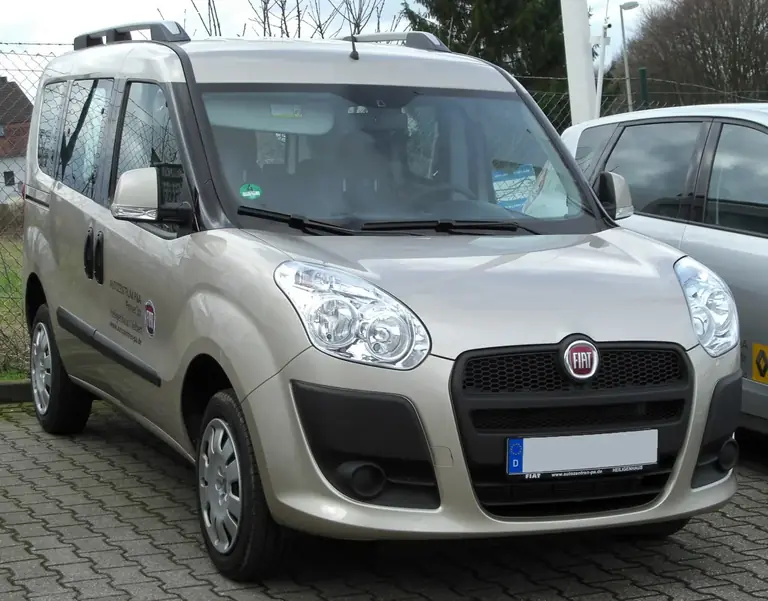
Plan d’maintenance Fiat Doblo II
Logo Fiat

Online service book

Generations :Doblò 1Doblò 2Doblò 3All →
Logo Fiat

📖Fiat Doblo II: passenger-car refinement backed by innovative Bi-link rear suspension

Fiat Doblo II (2009-2019)

Launched in late 2009, the second-generation Fiat Doblo (Type 263) marked a technological leap over its predecessor, built on an extended version of the Small Wide platform. Setting a new benchmark in ride comfort and payload management that challenged the Volkswagen Caddy and Ford Transit Connect, it combined professional carrying capacity with car-like composure, making dedicated Fiat Doblo maintenance vital to preserve its sophisticated independent running gear and modern Euro 5 engines.

Suivi free

Entrez votre number plate d’number plate afin de suivre freeement votre Doblo II

Garajo prépare votre garage et vous permet ensuite de suivre les maintenances, les rappels et les points à surveiller.

UKGB

Owner notes

The reassuring points, known weak spots and deadlines you should not let slip.

Reassuring points

Reliability
  • Bi-link independent rear suspension provides car-like handling, exceptional ride comfort unladen and confident payload stability.
  • The 1.6 MultiJet II 105 hp engine offers the optimum compromise of robust torque, high-speed motorway composure and fuel thrift.
  • Massive cargo capacity offering up to 3,400 litres in standard wheelbase models with low load sill height.
  • Improved cabin soundproofing, supportive seating and modern dashboard architecture compared to earlier commercial derivations.

Chronic weak spots

Keep an eye on
  • Bi-link rear suspension bushes: inspect multi-link arms, coil springs and shock absorbers for bush play and spring fractures.
  • Diesel particulate filter (DPF): verify DPF differential pressure sensor data and inspect engine oil dipstick for rising oil levels due to fuel dilution.
  • 1.3 MultiJet timing chain: check for cold-start chain clatter; urban stop-and-go usage accelerates chain link elongation.
  • Sliding side door mechanisms: inspect upper and lower roller bearings for flat spots and lubricate guide tracks regularly.
  • Front suspension lower wishbones: listen for knocks and examine rubber bushes for separation over broken road surfaces.

Critical deadlines

Do not miss
  • Engine oil and filter change every 15,000 km or 12 months using certified low-SAPS synthetic oil.
  • Timing belt, tensioner pulley and water pump renewal every 120,000 km or 5 years on 1.4 FIRE, 1.6 and 2.0 MultiJet engines.
  • Bi-link rear suspension geometry check, bush inspection and shock absorber test every 30,000 km.
  • Brake fluid replacement, cabin pollen filter change and diagnostic scan every 24 months or 30,000 km.

Fréquences d'maintenance recommandées

Service markers for petrol/diesel versions. Exact intervals vary by engine and model year.

Oil change

Every 15 000 km

Every 1 year

Service

Every 15 000 km

Every 1 year

Brake pads

Every 40 000 km

Every 2 years

Timing belt / chain

Every 100 000 km

Every 5 years

Battery (12 V)

Every 50 000 km

Every 4 years

Diesel particulate filter (DPF)

Every 100 000 km

Automatic regeneration while driving: regularly do 20 min on a fast road; preventive clean around 100,000 km

EGR valve

Every 80 000 km

Valve that soots up easily on diesels: a preventive clean avoids power loss and limp mode

Powertrains and average consumption

Average consumption from manufacturer data for the versions available in this generation.

Estimated average budget

Economical cost

Servicing a Fiat Doblo II sits about 10% cheaper than the market average.

Simple oil change~80
Full service~215
Front brake pads~110
Timing-belt kit~500
Tyres (set of 4)~400

* Indicative estimates for parts and labour.

Frequently asked questions about Fiat Doblo II

What are the common problems on the Doblo II?
Doblo II owners should especially watch: Bi-link rear suspension bushes: inspect multi-link arms, coil springs and shock absorbers for bush play and spring fractures. Diesel particulate filter (DPF): verify DPF differential pressure sensor data and inspect engine oil dipstick for rising oil levels due to fuel dilution. Garajo includes these watch points so you can act early.
When should you change the timing belt on a Doblo II?
The timing belt is usually replaced every 100,000 km or 5 years on this type of engine.
Where can I find the service book for the Fiat Doblo II?
Garajo offers a free digital service book, always up to date, with reminders and a detailed history for your Fiat Doblo II.
How much does it cost to service a Fiat Doblo II?
The service budget for a Fiat Doblo II sits about 10% cheaper than the market average. Allow about 215 € for a full service, for example. Garajo estimates your budget by powertrain and tracks what you actually spend, for free.
Which Fiat Doblo II powertrain is best for town use?
This model is only available as petrol/diesel. Fuel mix: 3 petrol versions ; 11 diesel versions ; 2 LPG versions. In town, petrol/LPG versions are usually the better match; diesel versions make more sense with regular long journeys.
Which Fiat Doblo II powertrain should you choose if you mostly drive on the motorway?
This model is only available as petrol/diesel. Fuel mix: 3 petrol versions ; 11 diesel versions ; 2 LPG versions. For regular motorway use, diesel versions of this model are usually the best fit (range and refinement at a steady speed).

Compatible engine oil

Which engine oil for Fiat Doblo II?

These links are limited to the engines of this generation when oil data is available.

Unsure between two viscosities?5W-30 vs 5W-400W-20 vs 5W-305W-30 vs 0W-30

Ne ratez plus jamais un maintenance

Gérez l'maintenance de votre Fiat Doblo II freeement.
Centralise your history and spending in a few clicks.Téléchargez le service book de votre Fiat Doblo II en PDF à tout moment.

Créer mon carnet (Free)