Plan d’maintenance Daihatsu Move (L9)
Logo Daihatsu

Online service book

Generations :Move (L9)Move Latte (L55)All →
Logo Daihatsu

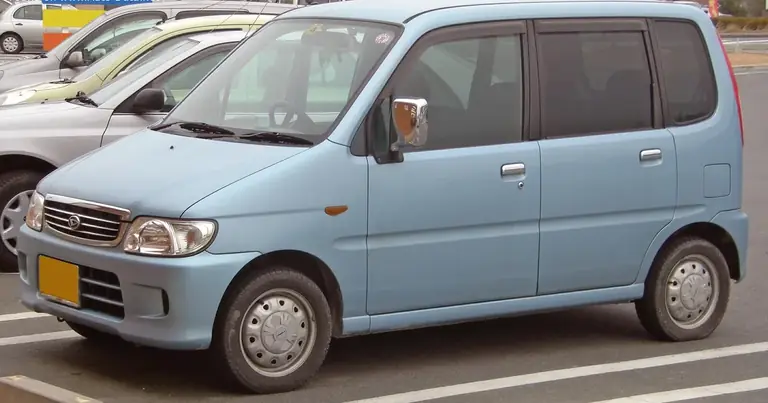
📖Daihatsu Move (L9): the 1998-2003 tall-boy micro-MPV

Daihatsu Move (L9) (1998-2003)

Featuring distinctive Giorgetto Giugiaro styling and an upright micro-monovolume silhouette, the Move L9 offers huge interior headroom and remarkable versatility within a microscopic footprint. Preserving this practical urban transport calls for disciplined Daihatsu Move maintenance, ensuring that its compact running gear and hardworking powertrain remain in top mechanical health.

Most export versions are powered by the 1.0-litre 12V 3-cylinder engine (EJ-DE) developing 55 hp, matched to a five-speed manual or an optional four-speed automatic transmission. The engine is driven by a rubber cambelt that requires scheduled replacement along with the water pump. On automatic examples, ageing transmission fluid causes sluggish gear shifts and jolts during low-speed manoeuvres, requiring periodic draining and refilling.

Suivi free

Entrez votre number plate d’number plate afin de suivre freeement votre Move (L9)

Garajo prépare votre garage et vous permet ensuite de suivre les maintenances, les rappels et les points à surveiller.

UKGB

Owner notes

The reassuring points, known weak spots and deadlines you should not let slip.

Reassuring points

Reliability
  • Remarkable interior packaging with expansive headroom and sliding/folding rear seats.
  • Side-opening rear door and low load sill make loading urban shopping and cargo effortless.
  • Punchy and economical 1.0-litre three-cylinder engine perfectly matched to city traffic.
  • Compact exterior dimensions allow parking in spots inaccessible to conventional hatchbacks.

Chronic weak spots

Keep an eye on
  • Cambelt kit on Move L9: the EJ-DE engine uses an external rubber timing belt that must be renewed on time.
  • Automatic transmission fluid condition: check ATF colour and smell to prevent harsh shifting and clutch slippage.
  • Front suspension drop links and wishbone bushes: upright body causes roll that accelerates bush wear.
  • Throttle body and idle speed control valve: carbon buildup leads to hunting revs and rough cold idle.
  • Side rear tailgate hinges and latch: check for sagging door alignment and water ingress through the rubber seal.

Critical deadlines

Do not miss
  • Cambelt kit and water pump replacement every 100,000 km or 60 months to protect the engine.
  • Engine oil and filter change every 10,000 km or 12 months using 5W-30 or 10W-40 oil.
  • Automatic gearbox fluid (ATF) service every 40,000 km to guarantee smooth shift quality.
  • Brake fluid replacement and brake system inspection every 24 months.

Fréquences d'maintenance recommandées

Service markers for petrol/diesel versions. Exact intervals vary by engine and model year.

Oil change

Every 15 000 km

Every 1 year

Service

Every 15 000 km

Every 1 year

Brake pads

Every 50 000 km

Every 2 years

Vehicle léger et modeste : usure des number platettes généralement modérée

Timing belt / chain

Every 100 000 km

Every 5 years

Battery (12 V)

Every 50 000 km

Every 4 years

Powertrains and average consumption

Average consumption from manufacturer data for the versions available in this generation.

Petrol and diesel powertrains

Petrol, diesel or LPG versions. The intervals shown cover the usual mechanical jobs.

Estimated average budget

Standard cost

Servicing a Daihatsu Move (L9) sits in line with the market average.

Simple oil change~100
Full service~240
Front brake pads~105
Timing-belt kit~650
Tyres (set of 4)~400

* Indicative estimates for parts and labour.

Frequently asked questions about Daihatsu Move (L9)

What are the common problems on the Move (L9)?
Move (L9) owners should especially watch: Cambelt kit on Move L9: the EJ-DE engine uses an external rubber timing belt that must be renewed on time. Automatic transmission fluid condition: check ATF colour and smell to prevent harsh shifting and clutch slippage. Garajo includes these watch points so you can act early.
When should you change the timing belt on a Move (L9)?
The timing belt is usually replaced every 100,000 km or 5 years on this type of engine.
Where can I find the service book for the Daihatsu Move (L9)?
Garajo offers a free digital service book, always up to date, with reminders and a detailed history for your Daihatsu Move (L9).
How much does it cost to service a Daihatsu Move (L9)?
The service budget for a Daihatsu Move (L9) sits in line with the market average. Allow about 240 € for a full service, for example. Garajo estimates your budget by powertrain and tracks what you actually spend, for free.
Which Daihatsu Move (L9) powertrain is best for town use?
This model is only available as petrol/diesel. Fuel mix: 4 petrol versions. In town, prefer the most economical, well-serviced petrol/diesel version.
Which Daihatsu Move (L9) powertrain should you choose if you mostly drive on the motorway?
This model is only available as petrol/diesel. Fuel mix: 4 petrol versions. On the motorway, prefer petrol/diesel versions with the best power-to-consumption compromise.

Ne ratez plus jamais un maintenance

Gérez l'maintenance de votre Daihatsu Move (L9) freeement.
Centralise your history and spending in a few clicks.Téléchargez le service book de votre Daihatsu Move (L9) en PDF à tout moment.

Créer mon carnet (Free)