Plan d’maintenance Daihatsu Terios I (J100)
Logo Daihatsu

Online service book

Logo Daihatsu

📖Daihatsu Terios I (J100): the 1997-2006 compact 4x4 pioneer

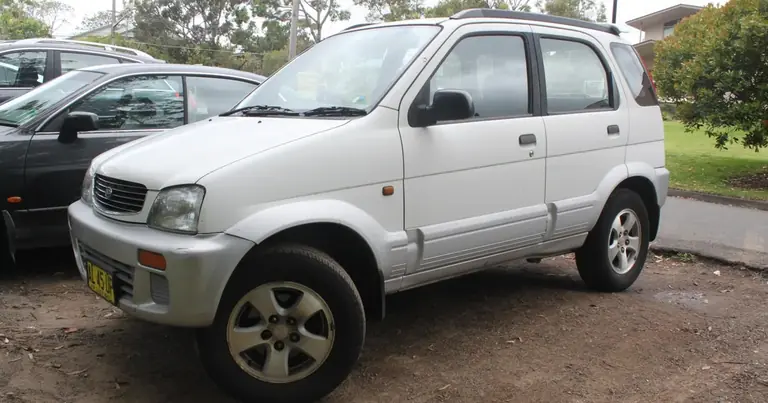
Daihatsu Terios I (J100) (1997-2006)

The original Daihatsu Terios J100 carved out a unique niche as a featherweight, narrow-bodied off-roader combining true permanent four-wheel drive with genuine urban agility. Unlike modern soft-roaders, proactive Daihatsu Terios maintenance is imperative to keep its robust mechanical transfer case, live axles and cooling hardware performing safely over rough terrain and motorway mileage alike.

Power is supplied by the 1.3-litre 16V petrol engine (HC-EJ or later K3-VE), including the rare turbocharged K3-VET in select markets. Early HC-EJ units require scheduled cambelt kit replacement, whereas K3 engines adopt a timing chain. On the driveline front, the standard full-time four-wheel-drive system features an electro-pneumatic centre differential lock, which must be tested on loose surfaces to confirm that the dashboard indicator illuminates and the differential disengages smoothly without mechanical binding.

Suivi free

Entrez votre number plate d’number plate afin de suivre freeement votre Terios I (J100)

Garajo prépare votre garage et vous permet ensuite de suivre les maintenances, les rappels et les points à surveiller.

UKGB

Owner notes

The reassuring points, known weak spots and deadlines you should not let slip.

Reassuring points

Reliability
  • Genuine compact 4x4 off-road capability thanks to permanent four-wheel drive and an electro-pneumatic centre diff lock.
  • Rugged mechanical construction capable of tackling harsh terrain and winter conditions without fuss.
  • Compact body dimensions and narrow track making it ideal for narrow country lanes and urban parking.
  • Dependable naturally aspirated petrol engines with straightforward accessibility for routine home maintenance.

Chronic weak spots

Keep an eye on
  • Rubber cambelt on 1.3 HC-EJ engine: requires timely replacement along with the water pump to avert valve damage.
  • Radiator top plastic tank cracking: age and heat cycling cause hairline cracks, resulting in sudden coolant loss and head gasket failure.
  • Centre differential lock and 4WD driveline: unmatched tyre wear leads to driveline windup and whining transfer box gears.
  • Rear wheel bearings and axle seals: humming or rumbling noises from the solid rear axle indicate failing wheel bearings.
  • 1.3 Turbo K3-VET turbocharger and oil feeds: check for blue exhaust smoke on overrun and inspect boost hoses for splits.

Critical deadlines

Do not miss
  • Cambelt kit and water pump replacement every 70,000 km or 60 months on the 1.3 HC-EJ engine.
  • Engine oil and filter change every 10,000 km or 12 months (5,000 km on 1.3 Turbo variants).
  • Gearbox, transfer case and front/rear differential oil replacement every 40,000 km or 24 months.
  • Propshaft universal joint inspection and chassis rust prevention treatment every 20,000 km.

Fréquences d'maintenance recommandées

Service markers for petrol/diesel versions. Exact intervals vary by engine and model year.

Oil change

Every 15 000 km

Every 1 year

Service

Every 15 000 km

Every 1 year

Brake pads

Every 40 000 to 50 000 km

Every 2 years

Vehicle léger et modeste : usure des number platettes généralement modérée

Timing belt / chain

Every 100 000 km

Every 5 years

Battery (12 V)

Every 50 000 km

Every 4 years

Powertrains and average consumption

Average consumption from manufacturer data for the versions available in this generation.

Petrol and diesel powertrains

Estimated average budget

Standard cost

Servicing a Daihatsu Terios I (J100) sits in line with the market average.

Simple oil change~85
Full service~270
Front brake pads~120
Timing-belt kit~650
Tyres (set of 4)~360

* Indicative estimates for parts and labour.

Frequently asked questions about Daihatsu Terios I (J100)

What are the common problems on the Terios I (J100)?
Terios I (J100) owners should especially watch: Rubber cambelt on 1.3 HC-EJ engine: requires timely replacement along with the water pump to avert valve damage. Radiator top plastic tank cracking: age and heat cycling cause hairline cracks, resulting in sudden coolant loss and head gasket failure. Garajo includes these watch points so you can act early.
When should you change the timing belt on a Terios I (J100)?
The timing belt is usually replaced every 100,000 km or 5 years on this type of engine.
Where can I find the service book for the Daihatsu Terios I (J100)?
Garajo offers a free digital service book, always up to date, with reminders and a detailed history for your Daihatsu Terios I (J100).
How much does it cost to service a Daihatsu Terios I (J100)?
The service budget for a Daihatsu Terios I (J100) sits in line with the market average. Allow about 270 € for a full service, for example. Garajo estimates your budget by powertrain and tracks what you actually spend, for free.
Which Daihatsu Terios I (J100) powertrain is best for town use?
This model is only available as petrol/diesel. Fuel mix: 4 petrol versions. In town, prefer the most economical, well-serviced petrol/diesel version.
Which Daihatsu Terios I (J100) powertrain should you choose if you mostly drive on the motorway?
This model is only available as petrol/diesel. Fuel mix: 4 petrol versions. On the motorway, prefer petrol/diesel versions with the best power-to-consumption compromise.

Compatible engine oil

Which engine oil for Daihatsu Terios I (J100)?

These links are limited to the engines of this generation when oil data is available.

Unsure between two viscosities?5W-30 vs 5W-400W-20 vs 5W-305W-30 vs 0W-30

Ne ratez plus jamais un maintenance

Gérez l'maintenance de votre Daihatsu Terios I (J100) freeement.
Centralise your history and spending in a few clicks.Téléchargez le service book de votre Daihatsu Terios I (J100) en PDF à tout moment.

Créer mon carnet (Free)