Plan d’maintenance Daihatsu Terios II (J200)
Logo Daihatsu

Online service book

Logo Daihatsu

📖Daihatsu Terios II (J200): civilised compact SUV durability

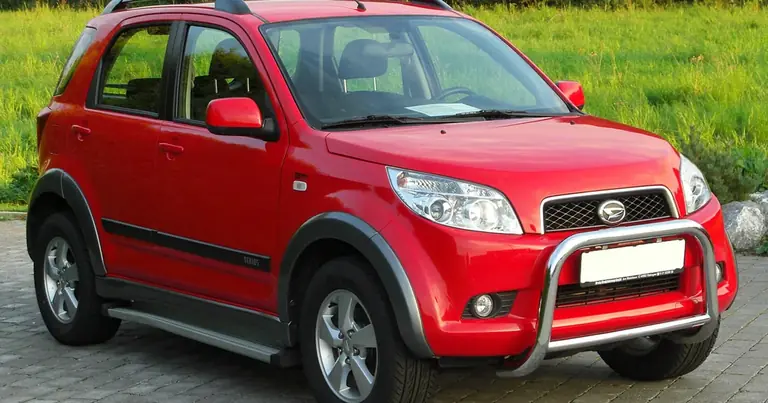
Daihatsu Terios II (J200) (2006-2017)

The second-generation Terios J200 significantly grew in breadth, comfort and refinement, transitioning from a narrow rural workhorse into a well-proportioned compact SUV while preserving genuine off-road capability. Methodical Daihatsu Terios maintenance ensures this versatile 4x4 delivers superb long-term reliability, as its mechanical components are simple, robust and largely derived from the Toyota parts bin.

Under the bonnet sits the bulletproof 1.5-litre four-cylinder 3SZ-VE petrol engine developing 105 hp, fitted with an enduring timing chain. While the core engine is exceptionally sturdy, the external water pump frequently develops pink coolant weeping around its pulley before 100,000 km. In addition, 4WD variants incorporate a full-time transfer case and a lockable centre differential, making periodic oil renewal of the 4WD transfer box and axle differentials critical to prevent gear whine.

Suivi free

Entrez votre number plate d’number plate afin de suivre freeement votre Terios II (J200)

Garajo prépare votre garage et vous permet ensuite de suivre les maintenances, les rappels et les points à surveiller.

UKGB

Owner notes

The reassuring points, known weak spots and deadlines you should not let slip.

Reassuring points

Reliability
  • Highly resilient 1.5-litre 3SZ-VE petrol engine co-developed with Toyota, equipped with a durable timing chain.
  • Permanent four-wheel-drive system with selectable centre differential lock delivering outstanding all-weather traction.
  • Spacious 5-door cabin and elevated driving position combining everyday practicality with genuine all-road confidence.
  • Relatively low servicing costs with readily available replacement mechanical components.

Chronic weak spots

Keep an eye on
  • Water pump seal and auxiliary belt on 3SZ-VE: inspect for pink coolant crusts around the pump pulley to prevent overheating.
  • Front wheel bearings: premature wear is common, producing an audible humming sound that intensifies during cornering.
  • 4WD transfer box and differential oil: skipping driveline oil changes leads to transfer case whine and tight-turn binding.
  • Electronic throttle body and idle valve: carbon contamination causes idle speed to drop excessively when air conditioning engages.
  • Exhaust line corrosion: rear silencer seams and mid-pipe flanges corrode prematurely on vehicles used for short journeys.

Critical deadlines

Do not miss
  • Engine oil and filter renewal every 15,000 km or 12 months (10,000 km under dusty or severe duty).
  • Transfer case and front/rear differential oil changes every 45,000 km to safeguard internal bevel gears.
  • Spark plug renewal every 30,000 km to protect the individual ignition coil packs.
  • Water pump and serpentine belt inspection every 60,000 km to preclude roadside coolant loss.

Fréquences d'maintenance recommandées

Service markers for petrol/diesel versions. Exact intervals vary by engine and model year.

Oil change

Every 15 000 km

Every 1 year

Service

Every 15 000 km

Every 1 year

Brake pads

Every 40 000 to 50 000 km

Every 2 years

Vehicle léger et modeste : usure des number platettes généralement modérée

Timing belt / chain

Every 100 000 km

Every 5 years

Battery (12 V)

Every 50 000 km

Every 4 years

Powertrains and average consumption

Average consumption from manufacturer data for the versions available in this generation.

Petrol and diesel powertrains

Petrol, diesel or LPG versions. The intervals shown cover the usual mechanical jobs.

Estimated average budget

Standard cost

Servicing a Daihatsu Terios II (J200) sits in line with the market average.

Simple oil change~80
Full service~270
Front brake pads~130
Timing-belt kit~650
Tyres (set of 4)~400

* Indicative estimates for parts and labour.

Frequently asked questions about Daihatsu Terios II (J200)

What are the common problems on the Terios II (J200)?
Terios II (J200) owners should especially watch: Water pump seal and auxiliary belt on 3SZ-VE: inspect for pink coolant crusts around the pump pulley to prevent overheating. Front wheel bearings: premature wear is common, producing an audible humming sound that intensifies during cornering. Garajo includes these watch points so you can act early.
When should you change the timing belt on a Terios II (J200)?
The timing belt is usually replaced every 100,000 km or 5 years on this type of engine.
Where can I find the service book for the Daihatsu Terios II (J200)?
Garajo offers a free digital service book, always up to date, with reminders and a detailed history for your Daihatsu Terios II (J200).
How much does it cost to service a Daihatsu Terios II (J200)?
The service budget for a Daihatsu Terios II (J200) sits in line with the market average. Allow about 270 € for a full service, for example. Garajo estimates your budget by powertrain and tracks what you actually spend, for free.
Which Daihatsu Terios II (J200) powertrain is best for town use?
This model is only available as petrol/diesel. Fuel mix: 3 petrol versions. In town, prefer the most economical, well-serviced petrol/diesel version.
Which Daihatsu Terios II (J200) powertrain should you choose if you mostly drive on the motorway?
This model is only available as petrol/diesel. Fuel mix: 3 petrol versions. On the motorway, prefer petrol/diesel versions with the best power-to-consumption compromise.

Compatible engine oil

Which engine oil for Daihatsu Terios II (J200)?

These links are limited to the engines of this generation when oil data is available.

Unsure between two viscosities?5W-30 vs 5W-400W-20 vs 5W-305W-30 vs 0W-30

Ne ratez plus jamais un maintenance

Gérez l'maintenance de votre Daihatsu Terios II (J200) freeement.
Centralise your history and spending in a few clicks.Téléchargez le service book de votre Daihatsu Terios II (J200) en PDF à tout moment.

Créer mon carnet (Free)